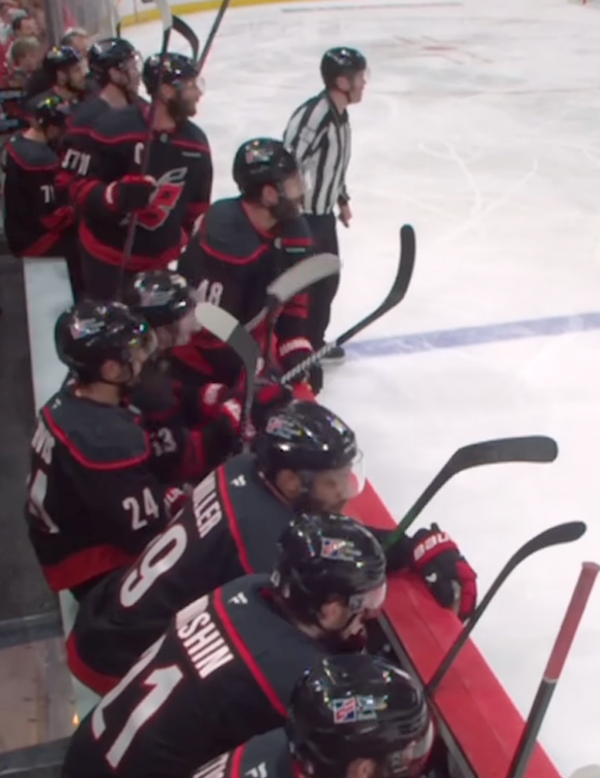
The Canes Won the Cup and the Market Already Moved On


Why Carolina slid from favorite to third on the 2027 board in six weeks
If you've been checking the 2027 Stanley Cup futures and thinking the number looks light for a team that just went 16-3 in the playoffs, you're not imagining it. Carolina has genuinely slipped.
Here's the movement. When the odds came out in mid-June, right after Game 6 in Vegas, Carolina opened as the favorite to repeat. Depending on the book, that was +650 to +700 — call it 13 percent implied. Some shops had Colorado a hair ahead, but Carolina was in the top spot at DraftKings and FanDuel.
As of this week, Florida is on top of the board and Carolina is sitting third at around 11 percent, roughly tied with Colorado.
That's not a collapse. But two points of implied probability in six weeks is a real move, and there are four reasons for it.
1. Frederik Andersen signed in Edmonton
This is the big one.
Andersen's regular season was rough — 16-14-5 with a .874 save percentage, and there were stretches where you watched him and winced. Then the playoffs started and he went 13-2 with a 1.89 GAA, a .910 save percentage, and three shutouts in 16 games. He was the reason the Ottawa and Philadelphia series were sweeps instead of grinds.
He signed a one-year deal with Edmonton on July 1. So the crease now belongs to Brandon Bussi and Pyotr Kochetkov.
To be clear, Bussi won the last three games of the Cup Final, including a 22-save shutout to close it out. That's not nothing. But "won three games in June" and "can carry 60 starts and a playoff run" are different questions, and the market doesn't have an answer for the second one yet. Goalie uncertainty moves futures numbers more than anything else, because the position has the widest range of outcomes.
2. Carolina did nothing on July 1
When free agency opened, the Hurricanes made zero signings. Not a bargain forward, not a depth defenseman. Nothing.
Their one real swing was trading for John Carlson's UFA rights, and then they couldn't get a contract done. He signed in Tampa. The draft went about the same way — multiple trades down, a C grade from the people who hand those out, and a decent second-round pick in William Hakansson.
There's a defensible logic here. You won the Cup with this group. Nikishin's development matters more than a mid-tier UFA. Eric Tulsky doesn't overpay on July 1, which is exactly why the roster is in good shape to begin with.
But futures markets price movement, and a team that stands still while everyone around it adds is going to drift. That's just how the math works.
3. Florida got a lot better in a hurry
The Panthers won the Cup in 2024 and 2025, then fell apart last year — 40-38-4, 84 points, no playoffs. Injuries were most of it. Bill Zito had a busy summer to fix it.
They landed Brady Tkachuk to play with his brother, and they brought in Jakob Markström for the crease. A healthy Florida roster with those two additions is a legitimate problem, and the market repriced them fast. They're the favorite now.
So part of Carolina's slide isn't about Carolina at all. It's Florida climbing over them.
Toronto has been loud too — new GM John Chayka signed Bobrovsky and made a pile of moves. Tampa added Carlson. The East got heavier while the Canes sat on their hands.
4. Repeating is hard and the market knows it
There have been 19 instances of a team winning back-to-back Cups in NHL history. Carolina has never done it. Florida is the most recent team to pull it off.
The structural reasons are boring and true: you play 25 extra games, your best players show up to camp with less in the tank, the cap doesn't care that you won, and everyone gets your best-of tape all summer. Books shade defending champions down for this every year.
So what does 11 percent actually mean
It means the market thinks Carolina is one of three or four teams with a real shot, which is where a healthy defending champion should be. Eleven percent in a 32-team league is roughly three and a half times baseline.
The honest read is that the slide is about one departure and one rival's shopping spree, not about anything Carolina lost internally. The core is intact. Brind'Amour is still here. The system that produced 53 wins and a 16-3 playoff run didn't leave in free agency.
If Bussi is real, the number goes back up by December. If he isn't, Tulsky will be shopping for a goalie at the deadline like everyone else.
Either way, they're still handing out the rings in October.